Loading content...
Loading content...
Loading content...
Loading content...
Loading content...

Loading content...
Loading content...
Loading content...
Loading content...
Loading content...
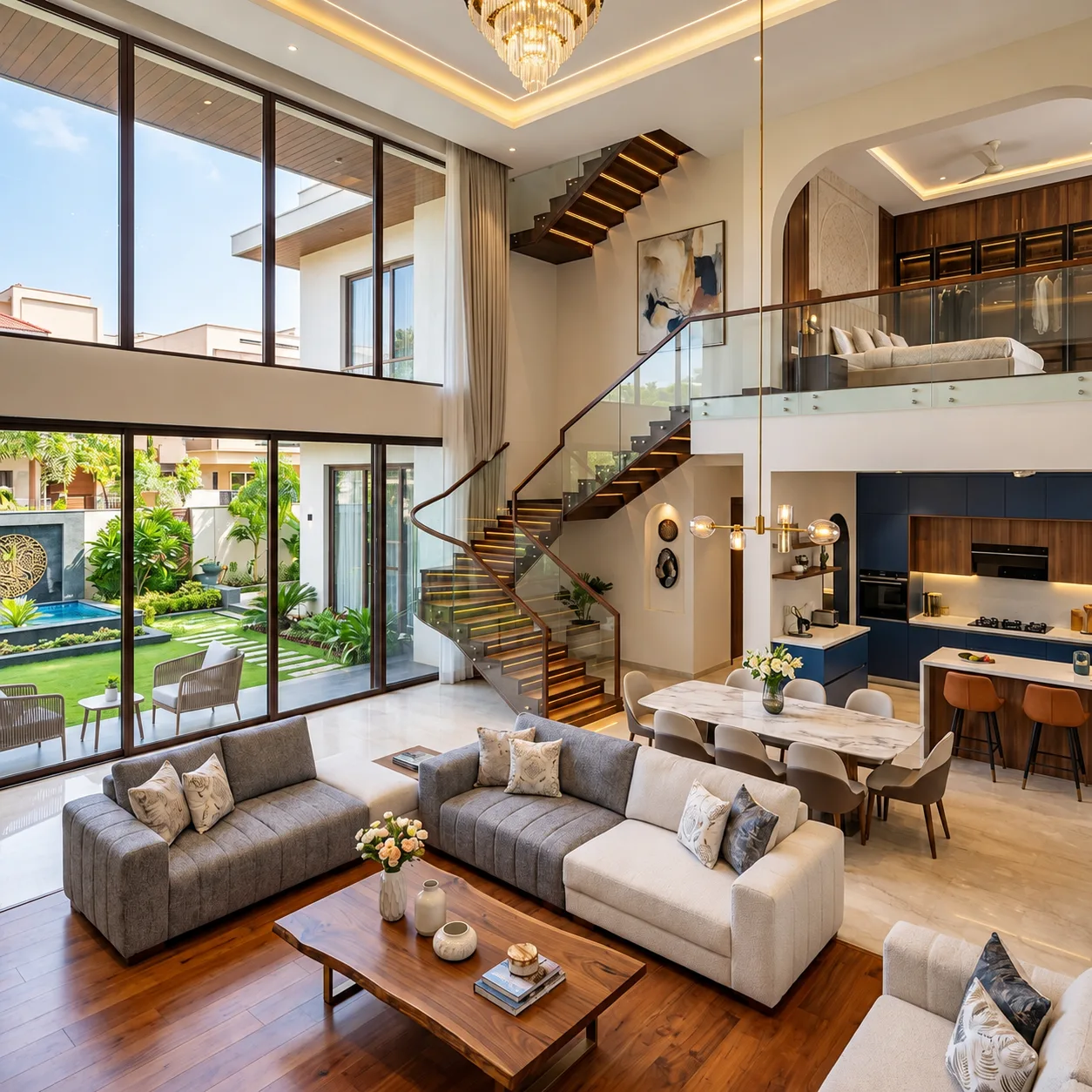
If you have started asking around, you already know the answer is not one clean number. A 4BHK villa interior in Sarjapur, Devanahalli, or Whitefield can cost anywhere from ₹35 lakhs to well over ₹1 crore, and the gap between those two figures is almost entirely about how well you allocate budget for interiors in your 4BHK villa not just how much you spend.
Two homeowners with the same ₹50 lakh budget can walk away with very different homes, simply because one put 25% into a kitchen that didn’t need it and the other prioritised the rooms they’d actually live in.
This guide gives you real cost ranges, a tier-by-tier comparison, and a room-wise breakdown so you can plan with numbers instead of guesswork. If you’re specifically weighing whether ₹50 lakh is enough for a 4,000 sq ft villa, our dedicated cost breakdown for that exact scenario goes deeper into that one budget point. This guide covers the full spectrum from ₹40L to ₹1Cr+.
Before allocating anything, it helps to know where your total number sits on the market spectrum. Here’s the realistic per-square-foot range for villa interiors across Sarjapur, Devanahalli, and Whitefield in 2026 (all figures exclude 18% GST):
| Finish Level | Cost per Sq Ft | What It Typically Looks Like |
| Basic | ₹1,200 – ₹1,600 | Laminate finishes, standard hardware, minimal false ceiling |
| Mid-Range | ₹1,600 – ₹2,400 | Branded modular kitchen, better wardrobe finishes, ceiling across key rooms |
| Premium | ₹2,400 – ₹3,500 | Upgraded countertops, designer lighting, staircase joinery, curated furniture |
| Ultra-Premium | ₹3,500 – ₹4,500+ | Bespoke furniture, imported materials, home automation, full landscape integration |
Direct answer: for a 3,800-4,000 sq ft villa, a mid-range interior typically lands between ₹45–55 lakhs, while a premium finish pushes that to ₹75 lakhs-₹1 crore+.
Here’s how the same villa type shifts in scope as the budget moves up:
| Budget | Realistic Coverage | Finish Level | Key Trade-Off |
| ₹40 Lakhs | 3,000-3,500 sq ft | Basic to mid | Limited terrace styling, standard hardware, tight contingency |
| ₹50 Lakhs | 3,500-4,000 sq ft | Mid | Branded kitchen, ceiling in main rooms, workable contingency buffer |
| ₹60 Lakhs | 3,800-4,200 sq ft | Mid-premium | Upgraded wardrobe finishes, better lighting design, staircase joinery included |
| ₹80 Lakhs | 4,000-4,500 sq ft | Premium | Premium modular brands, curated furniture, home theatre or pooja room detailing |
| ₹1 Crore+ | 4,500+ sq ft or luxury finish | Ultra-premium | Bespoke furniture, imported materials, full landscape and automation integration |
A lot of budget confusion comes from comparing quotes that don’t cover the same scope. Here’s what a typical villa interior quote should and usually doesn’t include:
Usually included:
Often excluded – confirm before you sign:
For a 3,800–4,000 sq ft villa at the mid-range tier, here’s roughly how that budget splits across rooms:
| Area | Estimated Cost | Share of Budget |
| Modular Kitchen | ₹9L – ₹11L | 20–25% |
| Wardrobes (4 bedrooms) | ₹7L – ₹8L | 15–18% |
| Living & Dining | ₹7L – ₹9L | 15–20% |
| False Ceiling & Lighting | ₹4.5L – ₹5.5L | 10–12% |
| Staircase & Landing | ₹2L – ₹3.5L | 5–8% |
| Bathrooms & Utility | ₹3.5L – ₹4.5L | 8–10% |
| Terrace/Balcony Styling | ₹2L – ₹3L | 5–7% |
| Contingency Reserve | ₹5L – ₹6.5L | 10–15% |
These figures scale proportionally at higher tiers an ₹80L budget roughly doubles the kitchen and furniture allocations while adding scope (home theatre, premium terrace decking) that a ₹45L budget simply can’t absorb.
Sarjapur, Devanahalli, and Whitefield all sit in Bangalore’s premium villa belt, but the starting conditions of each corridor genuinely change your allocation, not just the final bill.
Sarjapur Road: Villas here are largely in established gated communities with active vendor networks and easier site access, since most projects are ready-to-move or nearing handover. Budgets here tend to go further on execution timelines simply because logistics are smoother, though society-related overheads and premium land values in this corridor keep overall project costs on the higher side of the range.
Devanahalli: A large share of villa inventory near the airport corridor is handed over as a bare shell with no flooring finishes, no false ceiling, sometimes not even internal wall plastering done to a finish-ready standard. That shifts your allocation: a bigger share of the budget needs to go into foundational scope (flooring, ceiling, full kitchen-to-wardrobe build) before you even get to styling, since none of it exists on handover.
Whitefield: This is the most mature interior design market of the three, with the widest contractor and vendor competition. That competition tends to work in your favour on modular kitchen and furniture pricing, though older or resale villas here sometimes carry hidden civil correction costs plumbing and wiring updates that eat into the budget before interiors even begin.
If you’re weighing when to lock in these decisions relative to your construction stage, our guide on finalizing interior design during ongoing civil work explains why earlier planning protects the budget you’ve just built, rather than complicating it.
Numbers on a page are easier to trust when there’s a real project behind them. Our Regal Poise villa interior project in Sarjapur was a full-home design and execution scope on a villa in the 3,800–4,200 sq ft range, planned at a mid-premium tier. Roughly a quarter of the budget went into the living and dining zone alone the client’s priority with the master suite receiving the next largest allocation, while the three secondary bedrooms were kept to functional, simpler finishes to protect that spend. Staircase joinery and cove lighting were locked in during the civil stage, which avoided the rework costs that typically resurface once a villa is already move-in ready. You can see how that allocation translated into the finished spaces in the Regal Poise villa interior design project .
Once you have a rough number, our interior design services for Bangalore homes team can turn it into an actual room-by-room BOQ built around your villa’s layout and locality.
There’s no universal percentage split that works for every villa the right allocation depends on your locality’s starting condition, your must-have rooms, and how much contingency you’re willing to hold back. Anchor your numbers to real ₹/sq ft ranges, get a line-item quote before you commit, and you’ll spend the next 8–12 weeks solving design problems instead of budget ones.
1.What is a realistic interior budget for a 4BHK villa in Bangalore?
For a 3,800-4,000 sq ft villa, a mid-range interior typically costs ₹45–55 lakhs, while a premium finish pushes that to ₹75 lakhs–₹1 crore or more, excluding 18% GST.
2.Is ₹40 lakhs enough for a 4BHK villa interior?
₹40 lakhs covers a basic-to-mid finish for a 3,000–3,500 sq ft villa, but leaves little room for terrace styling or a large contingency buffer; it works best when you’re prioritising function over premium finishes.
3.How much should I keep as a contingency reserve?
Set aside 10–15% of your total budget as an untouchable buffer. Villas are more prone to mid-project surprises plumbing, waterproofing, and civil corrections than flats, so this line item shouldn’t be skipped.
4.Does GST apply on top of the quoted interior cost?
Yes. Most villa interior quotes in Bangalore exclude the 18% GST, so always confirm whether a number you’re comparing is pre- or post-tax before judging it against another quote.
5.Why do Devanahalli villas often cost more to furnish than Sarjapur or Whitefield ones? Many Devanahalli villas are handed over as a bare shell without flooring, false ceiling, or finished walls so a larger share of the budget goes into foundational work before any styling begins, unlike semi-finished villas in Sarjapur or Whitefield.
6.Which room should get the largest share of the budget?
The modular kitchen typically takes the largest single allocation at 20–25% of the total budget, followed by wardrobes across all bedrooms at 15–18%.
7.Should I finalize my interior budget before or after civil work is complete?
Before. Locking in design and budget decisions during the civil stage especially for staircase joinery, ceiling design, and electrical layouts avoids the rework costs that come from changing plans after the structure is finished.
8. Can I get an exact cost estimate for my villa?
General ranges are useful for planning, but the only way to get an accurate number is a line-item BOQ based on your villa’s actual sq ft, layout, and finish preferences:
book a free consultation
to get one for your home.

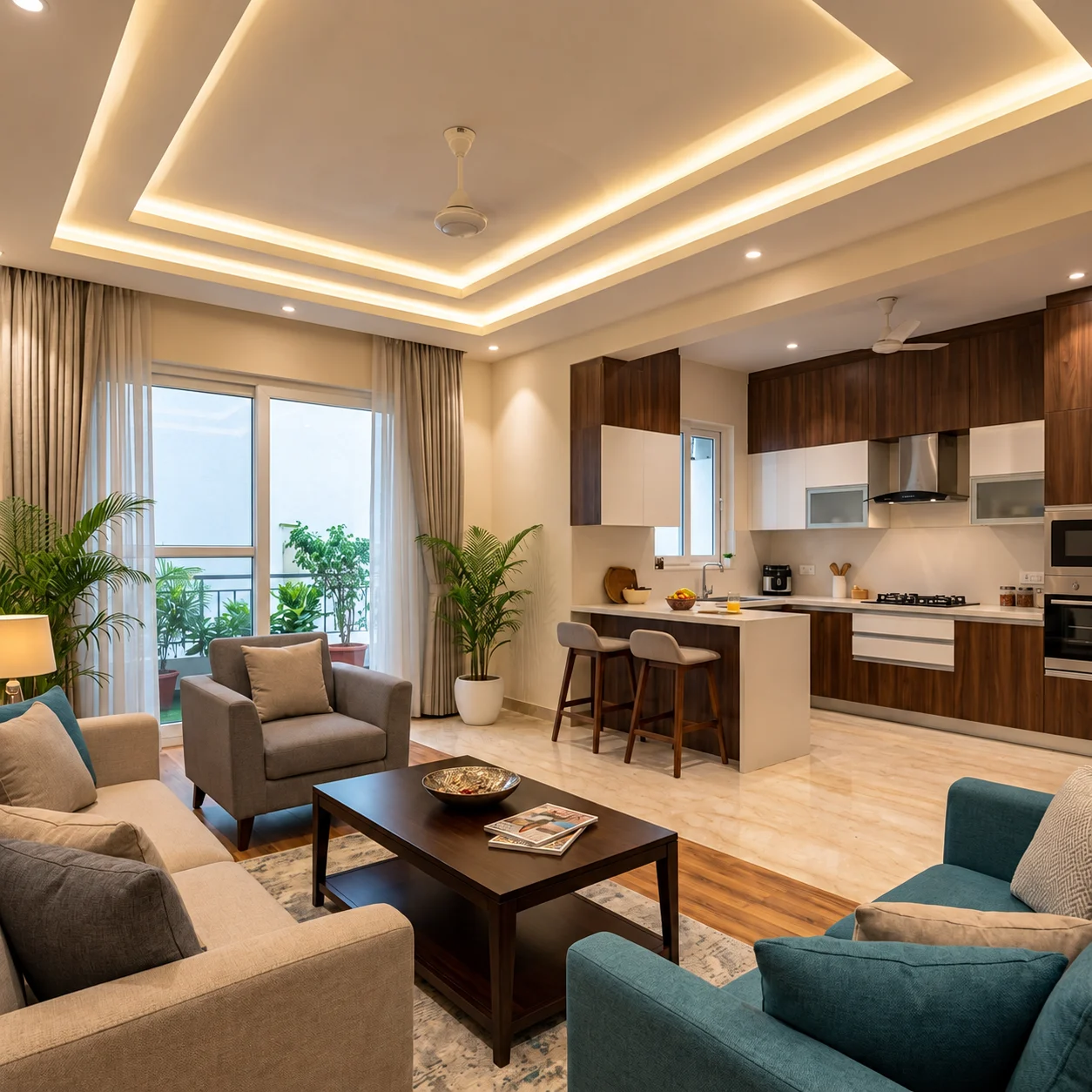
Once you have fixed a number in your head ₹30 lakh, ₹40 lakh, ₹50 lakh the harder question is where...
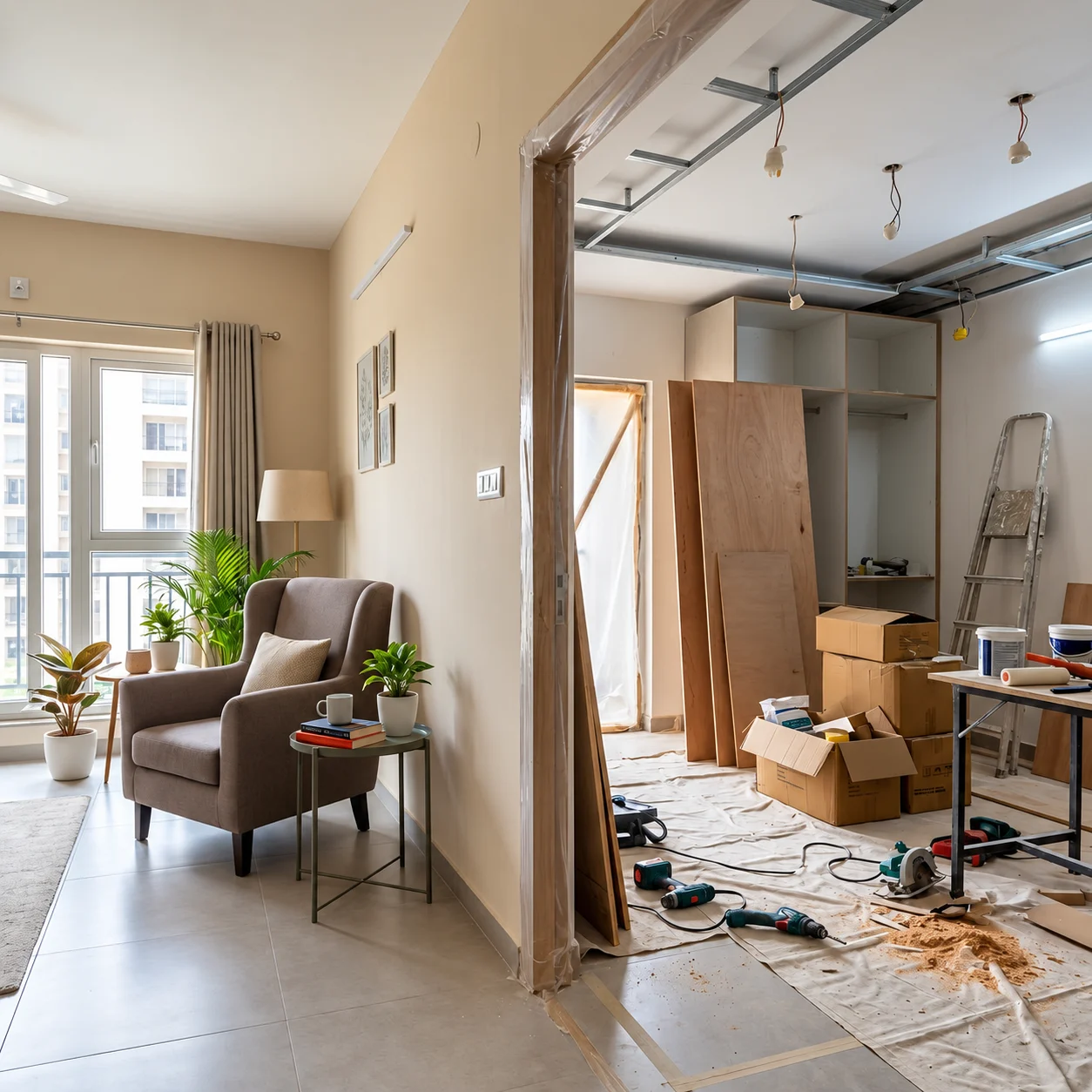
So your flat is almost ready, the builder has handed over the keys, and your rent in Whitefield or HSR...
Transform your vision into a cohesive, timeless space with Bangalore's award-winning design studio.
Book Your Free Consultation