Loading content...
Loading content...
Loading content...
Loading content...
Loading content...

Loading content...
Loading content...
Loading content...
Loading content...
Loading content...
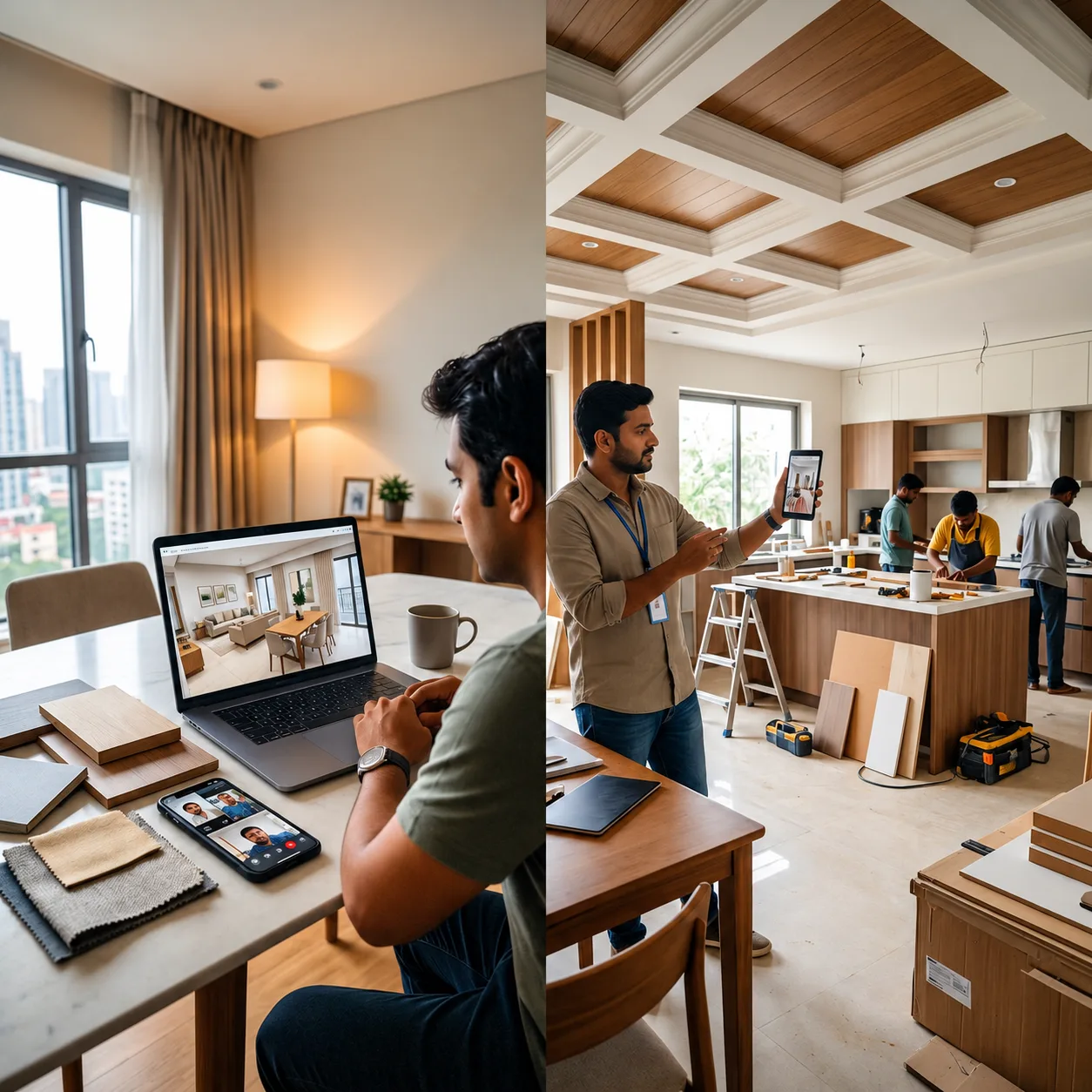
Yes, you can get your Bangalore home designed and finished while you live abroad. Remote interior design works when four things are in place:
If any one of these is missing, you end up relying on trust alone, and that is where most NRI interior projects go wrong.
This guide explains how each piece works and what a good update looks like. It also covers the parts NRIs often forget: society permissions, keys and handover. If you are still choosing a studio, start with our interior design services in Bangalore to see how we structure a project from brief to handover.
Remote interior design means you make every decision, but someone you trust carries it out on site. You approve layouts, materials and budgets from wherever you live. The design team and site supervisor turn those approvals into work on the ground and show you the evidence.
In other words, it is remote project management applied to your home. Some decisions travel well over a screen. Others are easier in person. Knowing the difference upfront saves you from surprises.
| Can be done fully from abroad | Better with someone on site (you, family or the studio) |
|---|---|
| Briefing and lifestyle discussion | Final colour check under real daylight |
| Layout and space planning | Opening the flat for the first measurement |
| 3D walkthrough approvals | Key handover to the site supervisor |
| BOQ (itemised quote) sign-off | Society or association paperwork that needs a signature |
| Weekly progress reviews | Final walkthrough before you move in |
| Payment releases | Collecting keys, manuals and warranty documents |
Most NRI clients nominate one local contact, usually a parent or sibling, for the right-hand column. If nobody is available, agree in writing which of those tasks the studio will handle.
Good remote tracking does not mean a flood of WhatsApp photos. It is a small set of updates that each answer a specific question.
A 3D walkthrough lets you “walk” through each room before any carpentry starts. Use it to check:
Changes cost almost nothing at this stage and a lot after fabrication.
At House of Crea, our concept stage includes mood boards, layout sketches and 3D renderings, so you can see the design before you commit to it.
A video call is only useful if it follows a route. Ask for the same sequence every time: entrance, living, kitchen, each bedroom, bathrooms, balcony. The supervisor should stop at anything that changed since the last call and show it close up.
A good video walk answers three questions:
Studios that regularly work with NRI clients usually offer a weekly video walkthrough, and some add short photo updates on WhatsApp between calls. At House of Crea, we share structured updates at every project milestone. Agree the day and time of your weekly call at the start, so it fits your time zone.
The most important photos are the ones of work that will soon be hidden:
Once these are covered, you cannot inspect them without breaking finished work. Ask for these “before-closing” photos with the date, and keep them. They are useful years later when you need to drill into a wall or trace a leak.
Photos show what happened. A short written report tells you what it means. Here is a simple format you can ask any studio to follow.
| Section | What it should contain |
|---|---|
| Week and stage | e.g. Week 5: carpentry installation |
| Work completed | Bullet list by room |
| Photos | Linked or attached, dated |
| Issues found | What went wrong and how it is being fixed |
| Decisions needed from you | With a deadline, e.g. “Approve bathroom tile by Friday” |
| Next week’s plan | What will start and what will finish |
| Payment status | Which milestone is due, and the proof that it was reached |
Weekly written or photographed reports are common among studios that run projects for overseas clients. If a studio cannot show you a sample report before you sign, ask why.
Every project follows the same broad stages. What changes for an NRI is how each stage is approved.
| Stage | What happens | How you take part from abroad |
|---|---|---|
| 1. Initial consultation and discovery | We learn how you live, what you need and your budget | Video call, shared floor plan, photos of homes you like |
| 2. Concept creation | Mood boards, layout sketches and 3D renderings | Review on video, comment on shared files |
| 3. Design refinement | Detailed plans, furniture and material selection | Material approval (see next section), BOQ sign-off |
| 4. Execution and styling | Site work, carpentry, installation | Weekly video walks, photo logs, milestone payments |
| 5. Final reveal and support | Handover, snag fixes, ongoing support | Final walkthrough by you or your local contact |
How long does it take? Our apartment projects typically take about 8 weeks, and villas 12 weeks or more, depending on scale and civil work. Larger homes have more phases to coordinate, and we explain where the time goes in our guide to how long a 4BHK interior project really takes.
Add a little extra time if approvals depend on you across time zones. A decision that sits unanswered for four days adds four days to the schedule.
This is the step NRIs worry about most, and with reason. A laminate that looks warm on your phone can look grey in a north-facing Bangalore bedroom.
A few ways to reduce the risk:
Studios used to overseas clients commonly do one of two things for the finishes that matter most: courier physical samples to your address abroad, or take the material board to a family member in Bangalore for a second look.
Paying from abroad is safest when every payment is tied to a stage you can verify, not to a calendar date.
A common pattern on Bangalore interior projects is:
GST is usually invoiced with each milestone.
The rule that matters for an NRI is simple: before each transfer, ask for the evidence that the stage is complete. That means approved 3D views and the final BOQ before production starts, photos of finished modules before installation, and a completed snag list before the last payment. We show how these stages fit into a full sample quote in our guide to 2BHK and 3BHK interior design costs in Bangalore.
If you are paying from an NRE or NRO account, confirm the transfer process with your bank before the first payment.
Most guides skip this part. It is often what delays NRI projects in their first two weeks.
Most Bangalore apartment associations and gated communities need some combination of the following before interior work starts:
Rules vary between complexes, even in the same area. If you are not in the city, decide early:
Put these names in writing and share them with the association. These rules also decide whether you can stay in the home while work continues, which we cover in moving in while interiors are ongoing.
For most interior work, an authorisation letter to the association and a clear contract with the studio are enough. A Power of Attorney (POA) is usually only needed when someone has to sign legal or registration documents for you. For example:
A POA signed abroad generally has to be attested at an Indian embassy or consulate (or apostilled, depending on the country), then stamped after it reaches India. Rules and fees change, so check the current process with the Indian mission in your country and with a lawyer in Karnataka before you sign anything.
Changes happen. You see the kitchen half-built on video and want an extra drawer stack. The problem is not the change itself. The problem is a change agreed verbally on a call, which then shows up as a surprise on the final bill.
Agree on a simple rule at the start: every change gets a written note with three things.
Approve it in writing, even a reply on email, before work continues. Our interior design contract checklist covers how change orders, revisions and payment terms should be written into the agreement.
Handover is where remote projects either end well or drag on for months.
Before the final payment, you or your local contact should receive:
If you arrive months after handover, ask for a quick check visit before your arrival. Dust, a stuck drawer or a dead switch are easier to fix before you have unpacked.
One of our recent projects was a 4BHK row villa at Prestige Elgin, Whitefield, for a returning NRI couple. Here are the key facts:
The main design challenge was a structural beam across the living and dining area that dropped the ceiling by 18 inches. Instead of hiding it under a flat false ceiling, we used a coffered ceiling that turned the beam into a soft divider between the two zones. The kitchen became a U-shaped layout with a 5-ft island, which the clients told us was the most-used surface in the house within a week.
You can read the full project breakdown, including costs, in our guide for villa interiors in Whitefield and Sarjapur.
Use this checklist on your first call with any studio.
| Question | A good answer sounds like |
|---|---|
| Who is my single point of contact? | A named person, with working hours that overlap with your time zone |
| How often will I get video walks and reports? | A fixed day each week, with a sample report shown to you |
| How do I approve materials I cannot touch? | Samples photographed in your room, couriered for key finishes |
| Is the quote itemised with brands and codes? | Yes, a BOQ, not a lump sum |
| How are payments linked to progress? | Milestones with proof, not dates |
| How are changes priced and approved? | A written change note before work continues |
| Who handles society permissions and keys? | A named person, agreed in writing |
| What is the warranty, and is it written? | Specific years for modular work and hardware, in the contract |
For a longer list of what to check before signing, see our questions to ask before hiring an interior designer.
Living in another time zone should not mean living with a home you never got to shape. If you own an apartment or villa in Bangalore and want it designed and finished while you are abroad, talk to us. Our first consultation is free. We will walk you through how we would run your project, from the first video call to the day you get your keys.
Book a free consultation with House of Crea
Yes. Briefing, design approvals, BOQ sign-off and progress reviews can all be done remotely. Someone still needs to be present for a few physical steps, such as key handover and the final walkthrough. That can be a family member or the studio, if agreed in writing.
Ask for dated photos of concealed work before it is closed, such as wiring, plumbing and waterproofing. Ask for scheduled video walks that follow a fixed route through the home. A snag-list video at handover, testing every fitting on camera, is the final check.
Ask for samples to be photographed in your actual room in daylight. Have physical samples couriered for the most important finishes. Make sure the BOQ lists brand names and codes, not general descriptions.
It is safer when payments are tied to milestones you can verify: design sign-off, delivery of finished modules, and handover with a completed snag list. Avoid paying most of the contract value before production starts. Check transfer rules for NRE and NRO accounts with your bank.
Usually not. An authorisation letter for the association and a clear contract with the studio are often enough. A POA is typically needed only for legal or registration matters, such as taking possession from a builder. Confirm the current process with the Indian mission in your country and a local lawyer.
Our apartment projects typically take about 8 weeks and villas 12 weeks or more. Slow approvals across time zones are the most common reason remote projects run late. Agree on a response time for decisions at the start.
A written warranty and a completed snag list protect you. Ask the studio for a short check visit a week before you land, so small issues are fixed before you move in.

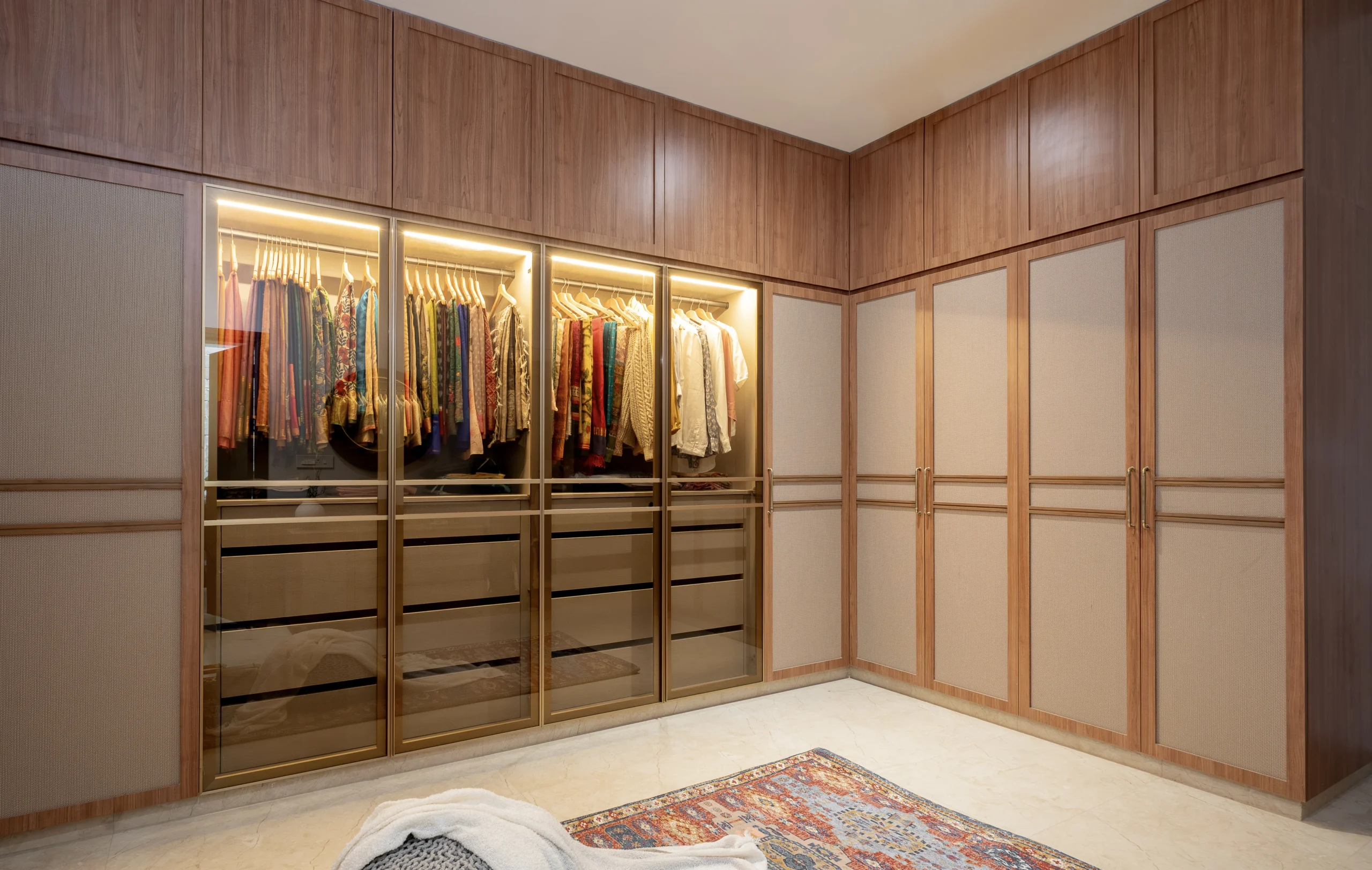
Published Bangalore pricing puts a standard laminate wardrobe in moisture-resistant (MR) plywood at roughly ₹1,100 to ₹1,700 per sq ft,...
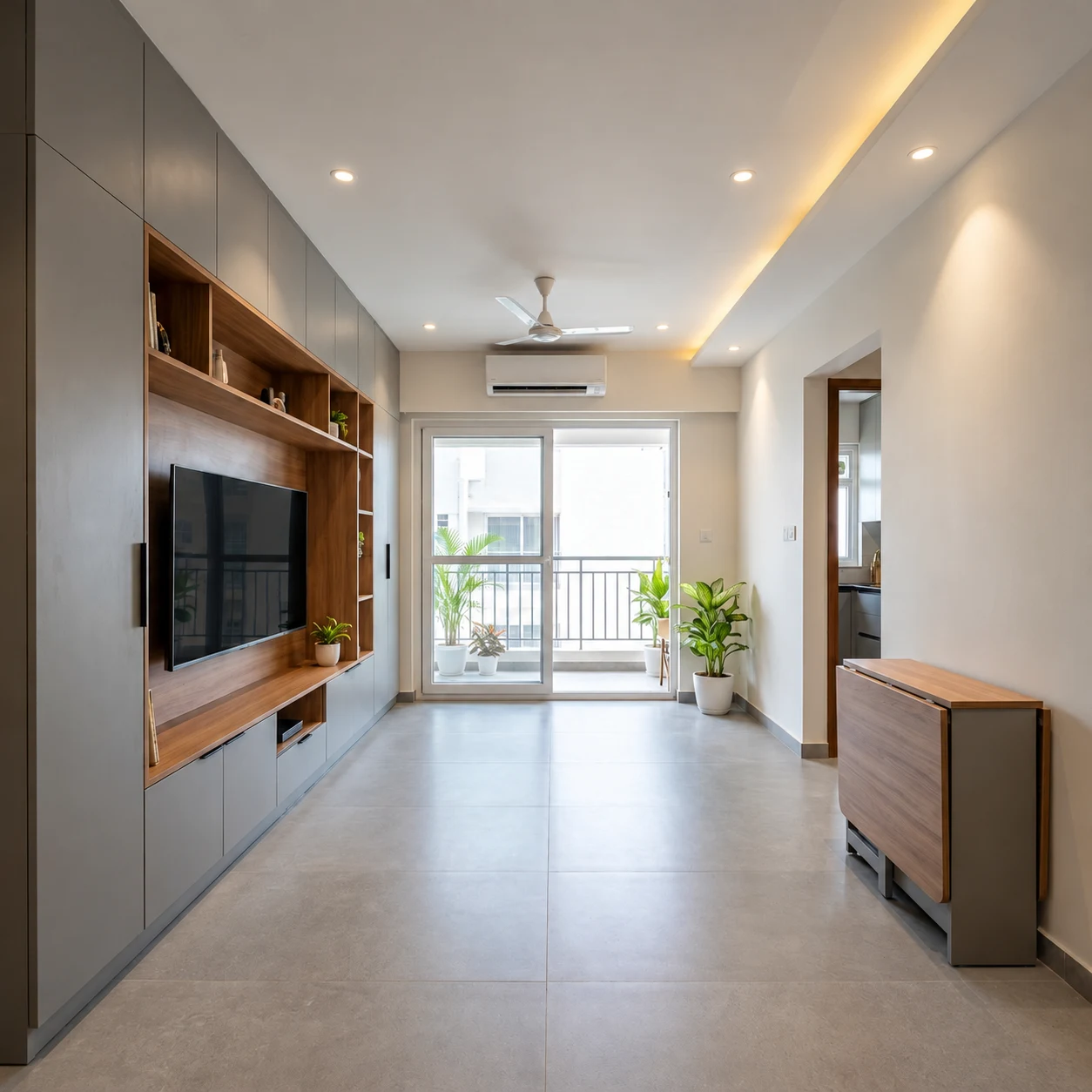
Start with the layout, not the furniture. Good compact flat interior design on Kanakapura Road comes down to four decisions:...
Transform your vision into a cohesive, timeless space with Bangalore's award-winning design studio.
Book Your Free Consultation